A lot of people, myself include, talk about the hamstrings without a clue as to how they function. Medical text books show the hamstring muscles on paper but which muscles contract and which extends. How do I know if I have weak hamstring muscles? Where does the pain come from?
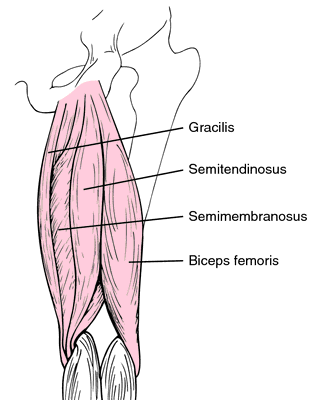
What is the hamstrings anyways? I used the term hamstrings a lot without much understanding. ” That area in the back of the legs is commonly known as the “hamstring.” The primary muscles of the “hamstring” group are semimembranosus, semitendinosus, and biceps femoris, located behind the leg, between the buttocks and the knee. Though each muscle can work independently, together they help bend the knee and bring the leg backwards. (And remember, our muscles work synergistically, never individually.) One muscle of the hamstring group also connects to a ligament that provides stability to the sacroiliac joint, the meeting point of the base of the spine and the pelvic bone. That same joint affects numerous important primary mover muscles in our backs. (Tight Hamstrings: Causes, Treatment, and Prevention by Andrew Duffy, NASM-CPT, PES July 27 2009) The tightness may be caused by 1) muscle weakness, 2) Pelvic tilt. When you have these two conditions, this may result in back pain because the back incorrectly compensates for the conditions.
So what can Anyone do to gain more flexibility and eliminate pain? F.Y.I, I still don’t have a clear picture of how the muscles work together. Anyways, I did a you tube search and found a video that I liked.
” 3 poses To Improve Hamstring Flexibility,” by Erkhartyoga.com
http://www.youtube.com/watch?v=aVsCcH_U_kc
1) Laying down, one leg at 90 degrees, the other straight with toes pointing up. You will need a rope. Lift leg to 90 degrees, or as close as possible, and the other leg straight, tadasana leg, 1 min both legs. ••• However, I recommend letting go of the belt after 15 seconds letting and maintain the posture for 45 seconds. I believe this will strengthen the muscles. This was something I discovered and was not part of the video.
2) Forward bend. Uttanasana,
3) Half splits. Arda hamasana.
As always, I am not a doctor nor a certified Iyengar yoga instructor, at least not yet. You should seek consul and instruction from the proper source.
This blog is for information only.

 The Yoga Bridge