The Yoga Bridge, Week 28, May 9, 2014, Gomukhasana

20140510-154238.jpg

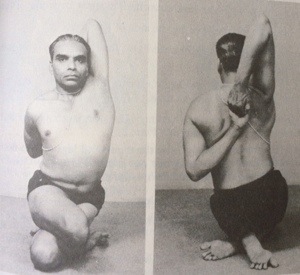
Gomukhasana, The cow pose. As per the photo. Step by step instruction can be found in ” Light On Yoga”, B.K.S. Iyengar, pages 114-116.

” Go means a cow. Mukha means face. Gomukha means one whose face resembles a cow. It also means a kind of a musical instrument, narrow at one end and broad at the other like the face of a cow.

Technique

1. Sit on the floor with the legs stretched straight in front. (Plate 77)

2. Place the palms on the floor and raise the seat.

3. Bend the left knee back and sit on the left foot  from the floor, raise the right leg and place the right thigh over the left one. Raise the buttocks and with the help of the hands bring the ankles and the back of the heels together till they touch each other.

4. Rest the ankles, keeping the toes pointing back.

5. Raise the left arm over the head, bend it at the elbow and place the left palm below the nape of the neck between the shoulders. Lower the right until the right hand is level with and between the shoulder-blades. Clasp the hands behind the back between the shoulders. (Front view: Plate 80. Back view: Plate 81) ”

** This information is for educational purposes only.  Doing yoga without proper instruction from a certified Iyengar teacher could be hazardous to oneself.  If seeking an instructor please see link.  https://secure.iynaus.org/search

When a cow sits down, they fold their legs. If one uses their imagination, the pose has some resemblance. Lately, the yoga studio has been doing this pose in every class.  Every time I did gomukhasana, I immediately felt a lot of pain in the deltoids and in both shoulder blades. A burning pain like a knife plunged into the shoulder-blades. Progress has been slow. After a year and half, not much progress. At present time,  no chance of grasping the fingers.  We use a strap to bridge the gap but its not very satisfying.   I wish I knew what was going on with the shoulders. Scar tissue in the shoulder joints? dislocation? Improper technique? An instructor, whom is a physical therapist,  told me I had lordosis and kyphosis. Is this related to the inability to clasp hands?

My home practices is sporadic. I had done yoga everyday but not a series nor at dawn. Time to get back on the saddle. Creating a home yoga practice will take time, multiple attempts, and perseverance because its a new habit.

Sutras study. I watched a few YouTube videos of people reciting Patanjali’s Samadhi Pada. Ok. It was a bit odd. I doubt that I will do the butchery of Sanskrit pronunciation on YouTube , which could make Patanjali cringe, unless there is a great out pour of blogger support. Learning the Samadhi Pada, unless a break through, will take six months.


The Yoga Bridge, Week 4, November 22, 2013 Dhanurasana / Yamas

photo (12)Back pain?  This week, we learned dhanurasana, the bow pose.   Dhanurasana gave immediate pain relief. This is a good pose for home practice. This pose can be found in ” Light On Yoga,” B.K.S. Iyengar’s book on page 101.   Here were the steps:

“1) Lie full length on the floor on the stomach, face downwards.

2) Exhale and bend the knees. Stretch the arms back and hold the left ankle with the left hand and the right ankle with the right hand. Take two breaths.

3) Now exhale completely and pull the  legs up by raising the knees above the floor, and simultaneously lift the chest off the floor. The arms and hands act like a bow-string to tauten the body like a bent bow.   (see above picture)

4) Lift up the head and pull it as far back as possible. Do not rest either the ribs or the pelvic bones on the floor. Only the abdomen bears the weight of the body on the floor.

5) While raising the legs do not join them at the knees, for then the legs will not be lifted high enough. After the full stretch upwards has been achieved, join together the thighs, the knees and ankles.

6) Since the abdomen is extended, the breathing will be fast, but do not worry about it. Stay in the pose to your capacity from 20 seconds to one minute.

7) Then, with an exhalation, release the ankles, stretch the legs straight, bring the head and the legs back to the floor and relax.

Effects

In this posture the spine is stretched back. Elderly people do not normally do this, so their spines get rigid. This asana brings back elasticity to the spine and tones the abdominal organs.  In my experience, persons suffering from slipped discs have obtained relief by the regular practices of Dhanurasana without being forced to rest or to undergo surgical treatment.”  (Light On Yoga, page 101)

Also this week, we were briefly lectured on the first limb of yoga. Yama.  The Yamas and Niyamas, the sanskrit words, are printed on the walls of the studio. The Yamas are similar to Theravada Buddhist five precepts. 1) no lying 2) no stealing 3) no intoxication alcohol 4) chastity 5) abstaining from harming living beings. When following the precepts, or the Yamas, the mind becomes fit for meditation.  A Theravada Buddhist monk gave this message. Meditation is what will change you. Yamas, ethical principles, were recommended to follow if you want to really understand yoga:

Ahimsa means non violence.
Asteya means freedom from greed.
Satya means not lying, truthfulness.
Brahmacharya means chasity, ethical sexual practice.
Aparigraha means non hording, non possessiveness.

One that is not here with the Yamas, but should be, Freedom from intoxication.