The Yoga Bridge, Week 12, The Eight Steps of Yoga Applied to Swastikasana

On Monday, at noon, I attended a level one yoga class. This was my third time to a level one class. The year before, I could mostly attend multilevel classes because of the lack of courses offered and time conflicts.

This week I thought it was informative how the yoga teacher tried to apply the eight steps, limbs, of yoga to swastikasana, the basic sitting pose. The instructor coached us into the correct posture for swastikasana. Now close the eyes and go inward. Then she began to talk about the eight steps of yoga as applied to swastikasana. Printed on the south side and west side upper corner of the room near the ceiling are the eight limbs in Sanskrit. She told us about 1) Yama and 2) Niyama as something we need to work on. Lifestyle, Yama has five principles, non violence, freedom from greed, chastity, truthfulness, and freedom from desire. Lifestyle, Niyama was cleanliness, contentment, study of ego. Then, the 3) posture, swastkasana, 4) breathing, focusing on the inhalation and exhalation without stopping, and 5) detachment to the external world, try to ignore the senses. 6) Concentration, not moving in the posture and going inward. 7) advanced concentration, not our skill level and finally, Super advanced, 8) when you lose the sense of your separate existence. Nothing else remains except the core of one’s being, the soul.

The Yoga Bridge, Week 8, December 20, 2013 Yoga, The Emotional Cleanse

photo (18)

After a Friday morning yoga class of intense back bends during Savasana, corpse pose,  I had a bad child hood memory surface, a memory almost 40 years old.  I had thought, at least hoped, to leave it in the past.  It was truly overwhelming. I fought back my emotions.  When I got alone, in my car, I let it rip.  What’s going on? I believe, in theory, that the body just like each cell has stored knowledge. I believe yoga to be emotionally cleansing. During corpse pose, the five minute cool down before the end of a class, I really try to mimic death, no movement except for the breath.  Each time, I want my old self to die and try to create a new better me.

At the yoga anniversary party, it was interesting to see people outside of yoga and how they behave.  A real yogi lives a yogi life both in the class and outside of it, Yama.

” Okay, everyone, jump or step your legs apart for UTTHITA TRIKONASANA, extended triangle posture.”  This is a pose that is done often in class.  Sometimes my mind goes blank as to what to do.   I am at a point where I am taking time to read to improve this pose.  During class, I have stopped asking questions because I view it as more as of an obstruction to the flow of the class; however, I will ask questions in the level one classes but not any of the advance unless I have pain or to avoid an injury.  I think its better to observe and imitate.

A great aid for yoga is the book, Yoga: THE PATH TO HOLISTIC HEALTH
. This is where I am getting the information and pictures.   I plan to read this section 108 times as in a mantra.  I haven’t tried this before so I will let you know how it goes, the mantra method of learning.

The Yoga Bridge, Week 7, December 13, 2013. James Murphy Improves the Yoga of a Local South Florida Community

When a yoga instructor gets instruction from a Senior Level Iyengar Teacher, the yoga community usually will benefit.

Here were three tips from James Murphy, Senior Yoga Iyengar Teacher of New York, from a recent seminar at Yogarosa, Hallandale, Florida. Note, I didn’t attend the seminar.

Prasarita Padottanasana.  Expanded leg intense stretch.  The best tip was doing the head and leg stretch.  I had never placed my head to the floor.  In fact, his technique has changed my mind-set from dread to enthusiasm for the challenge of that pose. With his modified technique, I was able to reach my head to the floor which I was never able to do it before; however, this pose remains a definite work in progress.

Vira Tadasana, laying down mountain pose. Another tip from James via class instructor,  was to relax the hamstrings on the floor.  When doing a leg extension, the hip and Tadasana leg didn’t move. The back hamstring remained on the floor.

Analogy of the drain pipe. If the drain pipe wasn’t straight, the water would pool. This drain pipe analogy was playing in my mind when I did Adhomukha Svanasana, aka, down ward dog.  When the arms were straight, they didn’t fatigue as easily and more stability.  Hand stretched above the head pose was less fatiguing when the arms were straighter, like the drain pipe.

The Yoga Bridge, Week 5, November 29, 2013 Exhaling into the Pose

” Begin the pose with an exhalation!”

On Monday in the multi level class at 10:00 am,  I experimented with using breath to go deeper in all the poses.  B.K.S. Iyengar mentioned in a book to go into the pose with an exhalation; however, I think that I didn’t fully understand this and I hadn’t heard any of the instructor say to do this.

Two weeks earlier, I became interested in flexibility.  I had a few questions. Could a person that was not flexible become flexible?   What could be done? Absolutely.. Breathing, tension, and relaxation helped flexibility.  My interest was caught from a book which led me to find a You Tube video by Pavel Tsatsouline, Russian martial artist.  Commrade!

Pavel Tsatsouline Relax Into Stretch part 1

https://www.youtube.com/watch?v=4IeG1ZgG4Us

Pavel stated that we were already flexible but our minds were rigid.  Ironically, the yoga instructor mentioned the same thing.  In fact, we did a pose where when we relaxed we were able to stretch much further.  It was the mind that was difficult.  

The Yoga Bridge, Week 4, November 22, 2013 Dhanurasana / Yamas

photo (12)Back pain?  This week, we learned dhanurasana, the bow pose.   Dhanurasana gave immediate pain relief. This is a good pose for home practice. This pose can be found in ” Light On Yoga,” B.K.S. Iyengar’s book on page 101.   Here were the steps:

“1) Lie full length on the floor on the stomach, face downwards.

2) Exhale and bend the knees. Stretch the arms back and hold the left ankle with the left hand and the right ankle with the right hand. Take two breaths.

3) Now exhale completely and pull the  legs up by raising the knees above the floor, and simultaneously lift the chest off the floor. The arms and hands act like a bow-string to tauten the body like a bent bow.   (see above picture)

4) Lift up the head and pull it as far back as possible. Do not rest either the ribs or the pelvic bones on the floor. Only the abdomen bears the weight of the body on the floor.

5) While raising the legs do not join them at the knees, for then the legs will not be lifted high enough. After the full stretch upwards has been achieved, join together the thighs, the knees and ankles.

6) Since the abdomen is extended, the breathing will be fast, but do not worry about it. Stay in the pose to your capacity from 20 seconds to one minute.

7) Then, with an exhalation, release the ankles, stretch the legs straight, bring the head and the legs back to the floor and relax.

Effects

In this posture the spine is stretched back. Elderly people do not normally do this, so their spines get rigid. This asana brings back elasticity to the spine and tones the abdominal organs.  In my experience, persons suffering from slipped discs have obtained relief by the regular practices of Dhanurasana without being forced to rest or to undergo surgical treatment.”  (Light On Yoga, page 101)

Also this week, we were briefly lectured on the first limb of yoga. Yama.  The Yamas and Niyamas, the sanskrit words, are printed on the walls of the studio. The Yamas are similar to Theravada Buddhist five precepts. 1) no lying 2) no stealing 3) no intoxication alcohol 4) chastity 5) abstaining from harming living beings. When following the precepts, or the Yamas, the mind becomes fit for meditation.  A Theravada Buddhist monk gave this message. Meditation is what will change you. Yamas, ethical principles, were recommended to follow if you want to really understand yoga:

Ahimsa means non violence.
Asteya means freedom from greed.
Satya means not lying, truthfulness.
Brahmacharya means chasity, ethical sexual practice.
Aparigraha means non hording, non possessiveness.

One that is not here with the Yamas, but should be, Freedom from intoxication.

The Yoga Bridge, Week 3, November 15, 2013 Halasana, the plow

halasanaThis Thursday, we did Halasana which means in Sanskrit, the plow.  To be honest, I couldn’t remember a yoga class without Salamba Sarvangasana, supported shoulder stand, the pre pose of Halasana.  As usual,  I struggled with Halasana.
Before I explain, from the perspective of a beginner student, the pose of Halasana, we need the setup of yoga props.  When we get to a certain level, props shouldn’t be necessary.  For Halasana, the pose required three Mexican blankets, a yoga mat, and block or a bolster.  Stack the blankets with the neat edge for the neck.   Place the block where the lower back would be.   Fold the yoga mat over the block and leave an inch on the blankets.  Lay on the mat and put the shoulders on the blankets with the neck an inch off the blankets.  Roll the shoulders under.  Grab the mat and swing the legs over the head and to the floor. Toes touch the floor and straight legs like in Tadasana.  Note, people without flexibility can use a folding chair at the other end so that toes rest on the seat.

About twelve months ago, I was strictly using a metal chair to prop my feet.  About three month ago, I was using a small wooden table to prop my feet, but on Thursday, I went to the floor but Halasana was not pretty.  Normally, when the instructor tells us to go into the pose,  I get a little tense, worried. ” Should I push myself or should I ease off?”    I know when I push myself to my limit, I rarely have regrets.  I went into the pose then came out.  On the second, attempt my feet went to the floor better.

When the legs were over head and on the floor, I had to calm my mind.  When the chin was close to my chest, I could only take half breaths. My mind debated if I was in pain.   I wanted to panic, almost yell.  I counted to thirty seconds to distract the mind.  For me, this pose demostrates the conflict of the mind and the body that were not any where near union.

The Yoga Bridge: Week 2, November 8, 2013

20140123-210450.jpg

Everyone was very excited that Dean Lerner was coming to teach at Yogarosas.  Dean was one of Iyengar’s master students. Unfortunately, I wasn’t able to attend.   The week before, all the yoga instructors asked all the students to invite anyone that was brand new to yoga because Dean wanted to teach an introductory class.

Rosa, owner and head instructor at Yogarosa, was recently at a yoga conference and came back with a message, ” Where ever you are in your yoga practice, step it up to the next level.”  Don’t do yoga with complacency.  I like the challenge.

This week, I was able to attend on Monday and Wednesday.  On Monday, the focus of the class was hip openers.  We worked a lot on Utthita Trikonasana but we would stop in the pose and work on the hip rotation and big toe.   We worked on a pre lotus position, Padmasana.

On Wednesday, we did some intense ham string stretches with Uttanasana except we would grab our big toe and pump our arms to get more length in the trunk.  We worked on Tadasana.  After a year of study, I don’t have mastery over any pose and  I find Tadasana one of the hardest.  Most of the class,  I struggled with my ego. Non stop chatter of negativity, but by the end of class I found peace.  

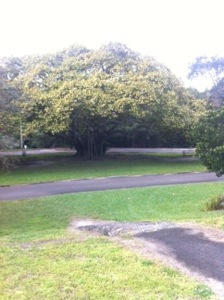
By myself, I did yoga at Greynolds Park under an enormous Banyan tree followed by meditation.

The Yoga Bridge, Wk 1, November 1, 2013 Demostration By Jason Scholder

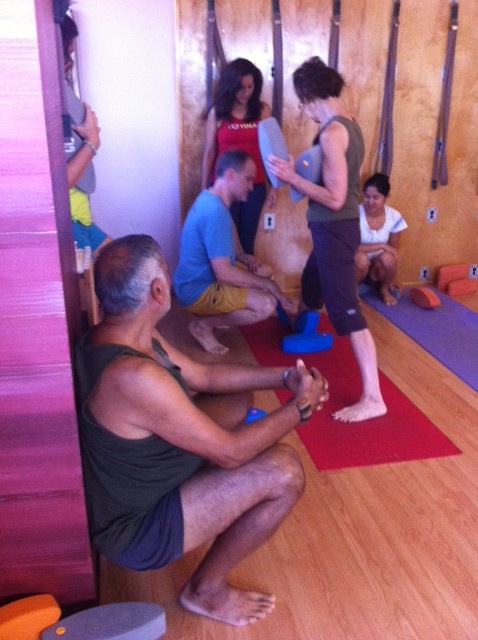
Egg Shaped Props, Demostration by Jason Shoulder at Yogarosa, Hallendale, fl

Egg Shaped Props, Demostration by Jason Scholder at Yogarosa, Hallendale, fl.

On Tuesday morning, at the 9:00 am yoga class, there was a demonstration of a new prop, a foam oval called the egg,  by the inventor, Jason Scholder.

As usual, we started the class in swastakasana, but instead of a blanket we used two eggs under the sit bones.  It was very comfortable and I felt a good stretch in my lower back.  Then we all said three Oms and the Invocation to Pantajali.

After that, we used the eggs in all the poses.  In Tadasana, the egg was less cumbersome and a lot more comfortable than a wooden block.  It was useful in other poses.   In my opinion, the egg was an improvement over a wooden block.

Next Newer Entries